The Wristwatch That Dialed 911: How Smartwatches Are Becoming America's Unexpected Health Guardians
The Wristwatch That Dialed 911: How Smartwatches Are Becoming America's Unexpected Health Guardians
Karen Michaels, 58, from suburban Columbus, Ohio, didn't think much of the notification that popped up on her Apple Watch on a Tuesday morning last fall. She was making coffee, barely awake, when her wrist buzzed with an alert she'd never seen before: Irregular rhythm detected. Possible atrial fibrillation.
"I almost dismissed it," she says. "I figured it was a glitch. I felt completely fine."
She mentioned it to her husband, who insisted she call her doctor. Within 48 hours, she was sitting in a cardiologist's office where a clinical ECG confirmed what her $399 wristwatch had already figured out: she had AFib. She was put on blood thinners the same week. "My cardiologist told me that catching it when we did probably prevented a stroke," Karen says. "I think about that a lot."
Stories like Karen's are no longer rare. Across the United States, a quiet but profound shift is underway — one where consumer wearable devices are stepping into a space that was once exclusively occupied by hospitals and medical professionals. And the implications, both inspiring and complicated, are enormous.
The Devices That Are Changing the Game
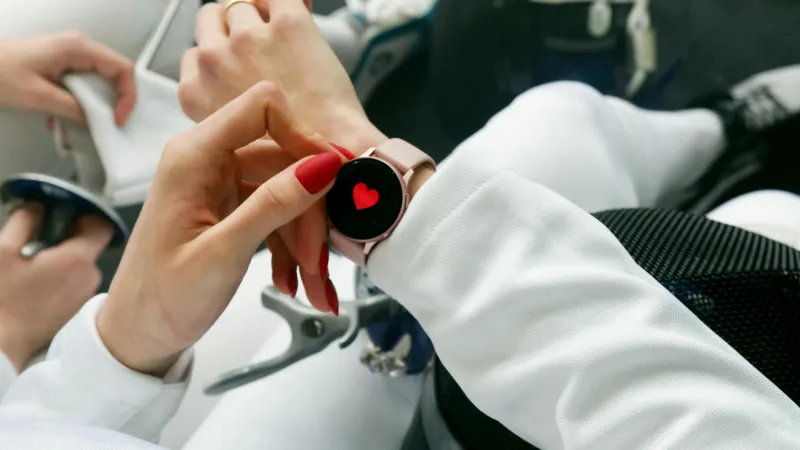
The wearable health tech market has exploded in recent years. Apple Watch, Fitbit (now under Google's umbrella), Garmin, Samsung Galaxy Watch, and a growing roster of competitors now offer features that would have seemed like science fiction a decade ago: real-time ECG readings, blood oxygen (SpO2) monitoring, irregular heart rhythm notifications, respiratory rate tracking, and even skin temperature sensors.
Apple Watch's AFib detection feature alone has generated extraordinary attention. Since its introduction, Apple has reported — and independent researchers have corroborated — that the ECG app has prompted thousands of users to seek medical care, with a meaningful percentage receiving genuine diagnoses. A 2019 study published in The New England Journal of Medicine involving over 400,000 Apple Watch users found that the device's pulse irregularity notifications had a positive predictive value of 84 percent — meaning when it flagged something, it was right the vast majority of the time.
Real People, Real Diagnoses
Dave Torrence, 44, a high school football coach in rural Tennessee, credits his Garmin Fenix watch with flagging a dangerously elevated resting heart rate over several consecutive nights. "It kept showing my overnight heart rate in the 90s and low 100s when it's usually in the 50s," he recalls. "I felt tired but I thought it was just the season."
His physician ran blood work and discovered an undiagnosed thyroid condition — hyperthyroidism — that was driving his heart rate up and, left untreated, could have led to heart failure or arrhythmia. "The watch didn't diagnose me," Dave is quick to clarify. "But it gave me the data to walk into that appointment and say, 'something is wrong.' That matters."
Then there's Priya Nair, 31, a software engineer in Austin, Texas, who wore a Fitbit Sense mostly to track her sleep. During the height of COVID-19, her device began logging unusually low blood oxygen readings — consistently dipping into the low 90s at night. "I wasn't feeling terrible, just a little off," she says. A visit to urgent care revealed she had COVID-induced pneumonia with oxygen levels low enough to require monitoring. "Without the watch, I genuinely don't know how long I would have waited."
What the Experts Actually Think
It would be easy to read these stories and conclude that smartwatches are the future of preventive medicine. The reality, as with most things in healthcare, is more nuanced.
"These devices are remarkable tools for raising awareness and capturing data over time," says Dr. Mintu Turakhia, a cardiac electrophysiologist and professor at Stanford University who has studied wearable cardiac monitoring extensively. "But they are screening tools, not diagnostic tools. There's a critical difference."
False positives are a real concern. Consumer-grade optical heart rate sensors — which measure blood flow through the skin using light — are inherently less precise than clinical ECG machines. Factors like a loose fit, motion artifacts, skin tone, and tattoos can all affect accuracy. An alert that sends a perfectly healthy person spiraling into medical anxiety (and expensive follow-up testing) carries its own costs.
The flip side — false negatives — is equally important. A wearable that misses a genuine arrhythmia because it only checks intermittently, or because the user wasn't wearing it during the episode, could create dangerous false reassurance.
"I worry about patients who feel their watch has given them a clean bill of health," says Dr. Turakhia. "Annual checkups, blood pressure monitoring, cholesterol panels — those don't become less important just because you have a device on your wrist."
Where the FDA Stands
The regulatory landscape around wearable health tech is evolving rapidly — and the FDA is working hard to keep pace. The agency has cleared several wearable ECG features as Class II medical devices, including Apple Watch's ECG app and AFib notification system. That clearance matters: it means these features have been reviewed for safety and efficacy, not just marketed as wellness novelties.
But the FDA has also been careful to frame cleared features as "over-the-counter" tools intended to inform, not replace, clinical evaluation. The agency has issued guidance cautioning against over-reliance on consumer wearables for medical decision-making — a stance that's likely to evolve as the technology matures and more clinical data accumulates.
Industry watchers expect the next few years to bring more sophisticated sensors, deeper AI-driven analysis, and potentially new FDA pathways for wearables that can detect conditions beyond heart rhythm — including sleep apnea, blood pressure, and even blood glucose levels without a finger prick.
The Bigger Picture
Perhaps the most transformative thing about wearable health tech isn't any single feature — it's the shift in mindset it encourages. When your watch surfaces your resting heart rate trends over 30 days, or shows you how alcohol affects your sleep quality, or buzzes your wrist with an irregular rhythm alert, it turns passive health consumers into active, engaged participants.
For a country where heart disease kills more people than any other condition, and where nearly half of American adults have some form of cardiovascular disease according to the American Heart Association, anything that gets people paying closer attention to their bodies is worth celebrating — with appropriate caveats.
Karen Michaels, back in Columbus, has become an unlikely evangelist for wearable health monitoring among her friends and family. She's bought Apple Watches for both her adult children. "I know it's not a doctor," she says, laughing. "But it's the thing that made me go see one. And that made all the difference."
Sometimes the most powerful medical device isn't in a hospital. Sometimes it's already on your wrist.
The stories in this article are based on firsthand accounts shared with Vital Pulse News. Wearable devices are not substitutes for professional medical evaluation. If you receive a health alert from a wearable device, consult a qualified healthcare provider.